One platform. Every property type.
A bank branch, an office tower, and an apartment community don't report the same issues, don't need the same people to see the same data, and don't measure success the same way. Bedrok Pro handles each as its own category — under one tenant, one login, one set of records.
A category is more than a label.
Each property category carries its own column schema, its own issue picklist, and its own access rules — so the same platform behaves differently where it needs to.
Its own schema
Bank branches, commercial, and multifamily exports don't share columns. Each category is validated against its own schema on import, so nothing has to be forced into a shared shape.
Its own issue picklist
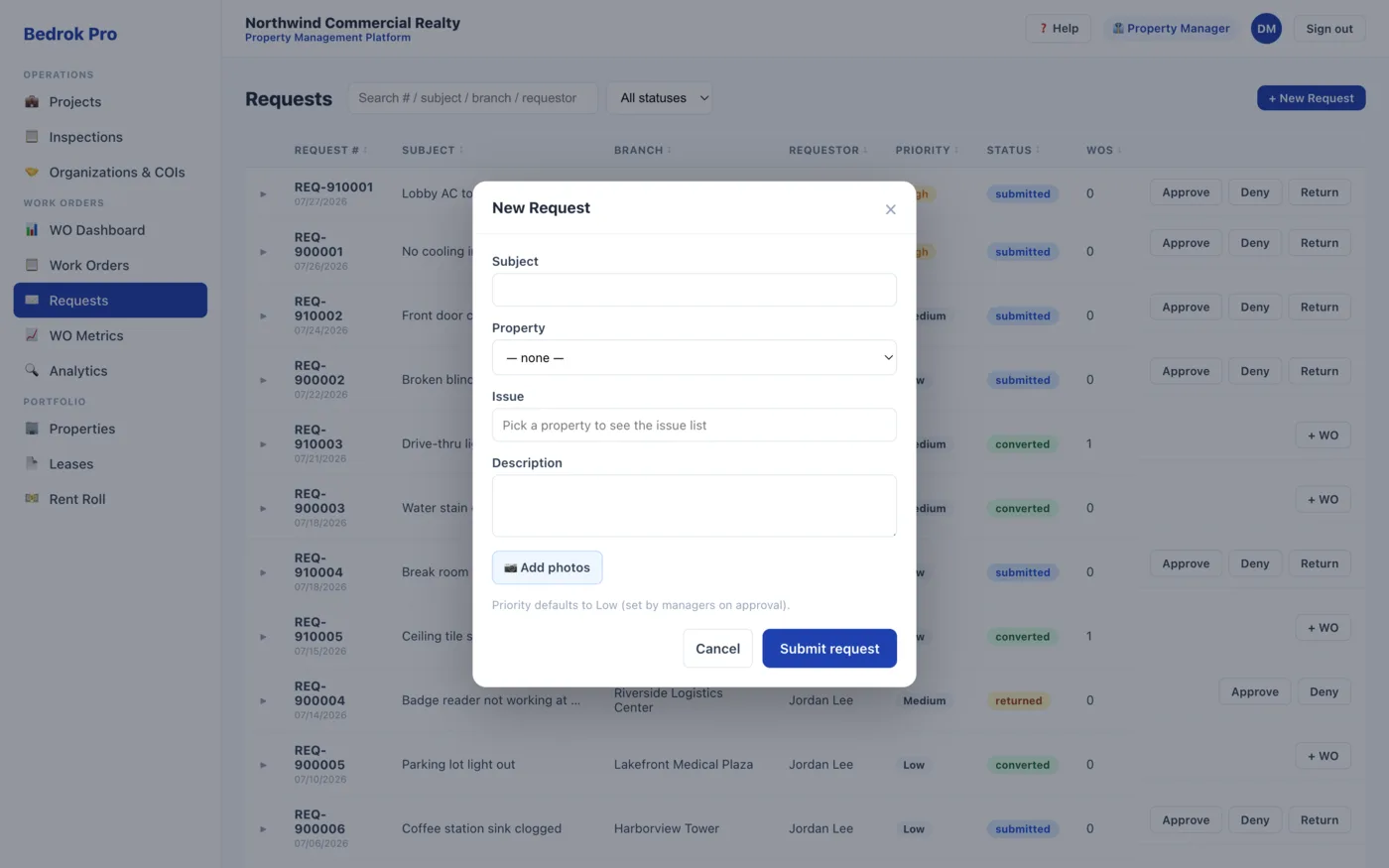
Requesters choose from a list that fits the property — vault and ATM at a branch, elevators and HVAC at an office. Real categories instead of free text, so reporting stays comparable.
Its own access rules
Scope a user to a category, a property, or a single branch. Enforced at the data layer, so a branch user's query simply can't reach another branch.
Built for networks of small, regulated sites.
Hundreds of locations, constant low-severity requests, and branch staff who just want the lights fixed — but with access and vendor rules that most facilities tools weren't designed to enforce.
- Dedicated Bank Requestor and Bank Manager roles — branch staff submit, branch managers oversee their branch, neither sees the rest of the network
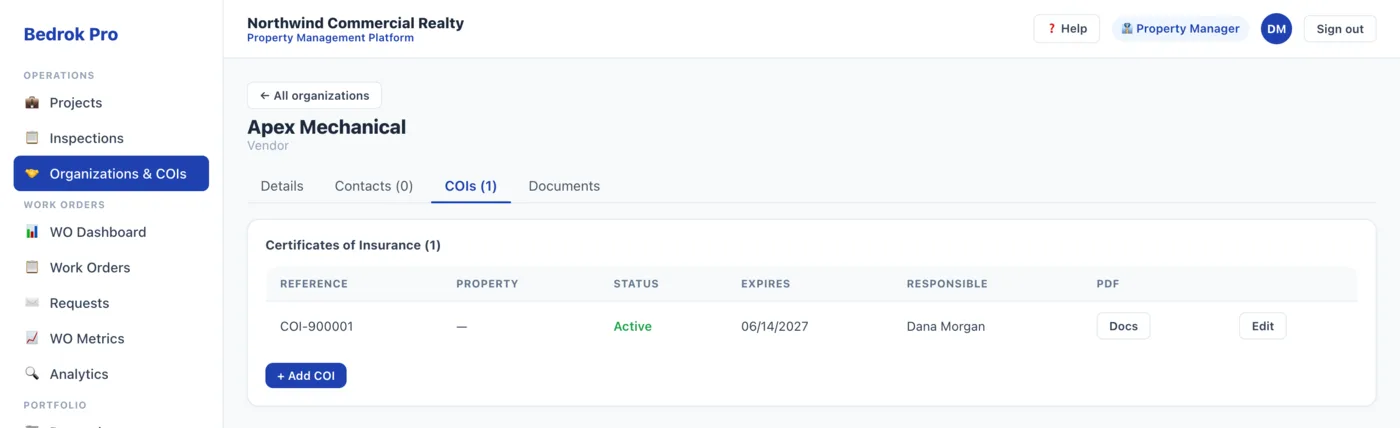
- Approved-vendor enforcement per property, so an uninsured or unapproved contractor can't be assigned to a site that requires one
- COI tracking with expiry alerts, so lapses surface before someone is dispatched, not after
- Branch-level ranking of volume, problems, and response times — accountability by location
- Photos on every request, so the branch shows you the problem instead of describing it
Where the lease matters as much as the work order.
Commercial
Fewer, larger buildings where a maintenance question is often really a lease question: who pays for the rooftop unit, and when does this tenant's option window close?
- Lease abstracts with parties, term, financials, and clauses in one record
- Rent schedules grouped by period, with per-period and total lease value
- Renewal options and a notice date calculated from the lease end date
- Suites with square footage and building-area allocation that blocks over-allocation
- Projects tracked from feasibility through construction, on the same engine
Multifamily
Resident-driven requests at volume, where turnaround time is the whole reputation and occupancy is the number ownership asks about.
- Resident requests triaged into tracked work orders with photos
- Response- and completion-time trends by property and vendor
- Occupancy and rent roll rolled up from suite-level records
- Vendor performance ranked by turnaround, not just spend
- Templated inspections with PDF reports for turns and move-outs
Mixed portfolio? It's one login.
Most teams run several property types at once, and the usual result is several systems — or one system bent into a shape it was never meant to take. Bedrok Pro keeps each category's schema, picklists, and access rules distinct inside a single tenant, so a manager sees the whole picture while each team stays in its lane.
Every client is an isolated tenant with its own branding and data, separated at the database with row-level security — not by application code remembering to filter.
Tell us about your portfolio.
We'll map your property categories and show you what Bedrok Pro looks like for your mix — loaded with your own export.